


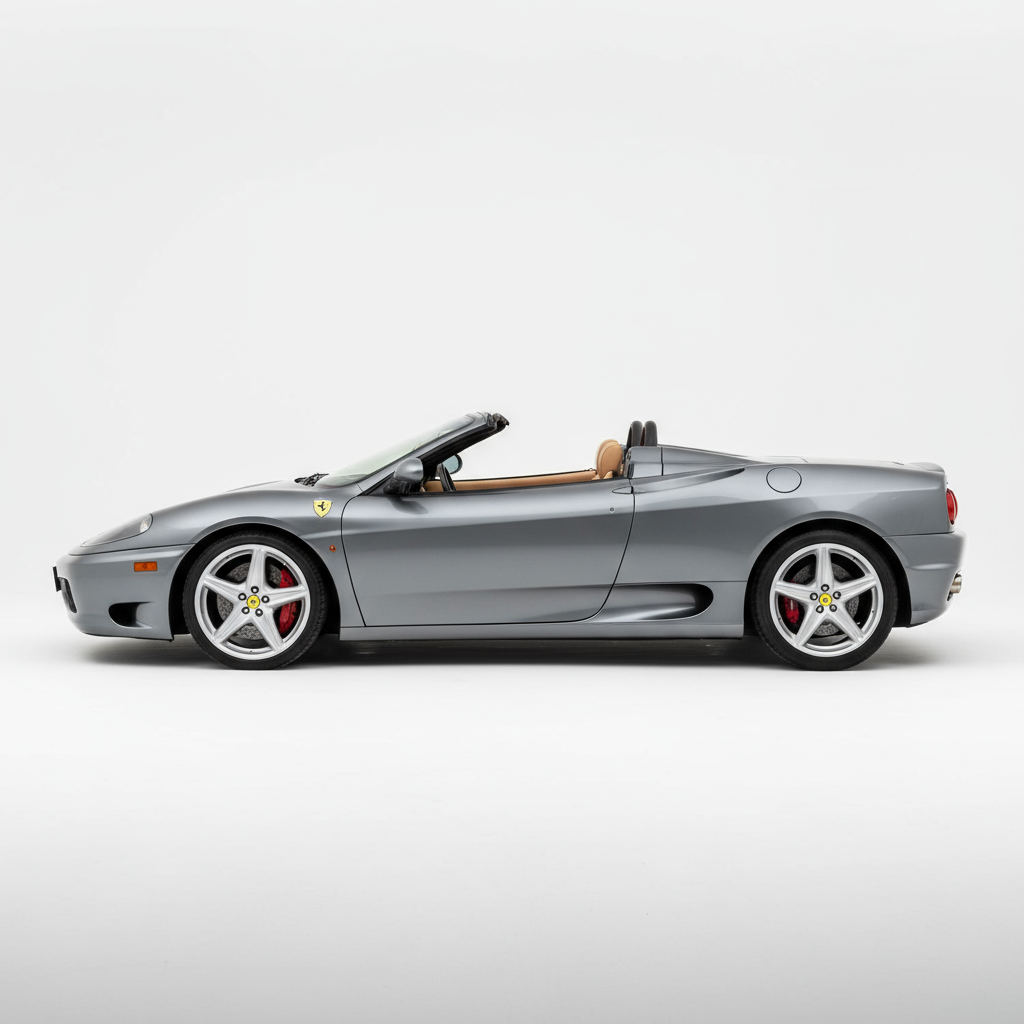

Especificaciones y análisis del Ferrari 360
Power
400HP
Torque
373Nm
Consumption
17.9l/100
Emissions
-g/km
0-100 km/h
4.6s
Top Speed
290km/h
Weight
1450kg
Price
178,432€
Technical summary
Gasolina
Automático 6v
RWD
2 / 2 doors
- L
95 L
294 kW
Current
Technical specifications
Engine
Capacities
Detailed analysis of the Ferrari 360 F1 Spider · 400 CV (1999-2005)
General description
The Ferrari 360 F1 Spider is not just a car, it's the materialization of an open-top dream. Born in 1999, it represented a revolution for Maranello, leaving the F355 behind to embrace a new era of aluminum and technology. Driving it is feeling the wind and sun as the Prancing Horse pushes you towards the horizon, an experience that redefines freedom.
Driving experience
Getting behind the wheel is a sensory overload. The sharp roar of the 3.6-liter V8, screaming up to 8500 rpm right behind your head, is an addictive melody. Each shift of the F1 transmission is a mechanical whip that connects you to the track, while the 0 to 100 km/h acceleration in 4.6 seconds pins you to the seat. You don't just drive it, you pilot it; you feel every imperfection of the asphalt as direct communication with the machine.
Design and aesthetics
Pininfarina sculpted a functional work of art. The fluid lines and sensual curves abandoned pop-up headlights for faired-in light clusters, marking a before and after. Its partially visible aluminum chassis and the iconic glass cover proudly displaying the V8 engine are not just aesthetic details; they are a statement of intent: beauty is born from the purest engineering.
Technology and features
It was a quantum leap for Ferrari. The 360 Spider was the brand's first model built entirely with an aluminum space-frame chassis, making it lighter and stiffer. Its V8 engine with five valves per cylinder was an engineering gem, and the F1 sequential transmission, derived directly from racing, allowed for lightning-fast shifts that made you feel like a race car driver on every journey.
Competition
In its time, the 360 Spider faced legends. The Porsche 911 Turbo Cabriolet (996) offered a more Germanic brutality and all-wheel drive, an efficient and technological beast. Shortly after, the Lamborghini Gallardo Spyder would arrive, with its V10 and a more angular, provocative design. Each represented a different philosophy of the convertible supercar, but the Ferrari always stood out for its balance of passion, sound, and agility.
Conclusion
The Ferrari 360 F1 Spider is more than a car; it's a milestone in automotive history and an unforgettable experience. It represents the perfect bridge between Ferrari's analog and digital eras, offering advanced technology without sacrificing the pure, visceral connection to driving. Owning one isn't having a vehicle; it's safeguarding a piece of Italian passion that will never go out of style.