


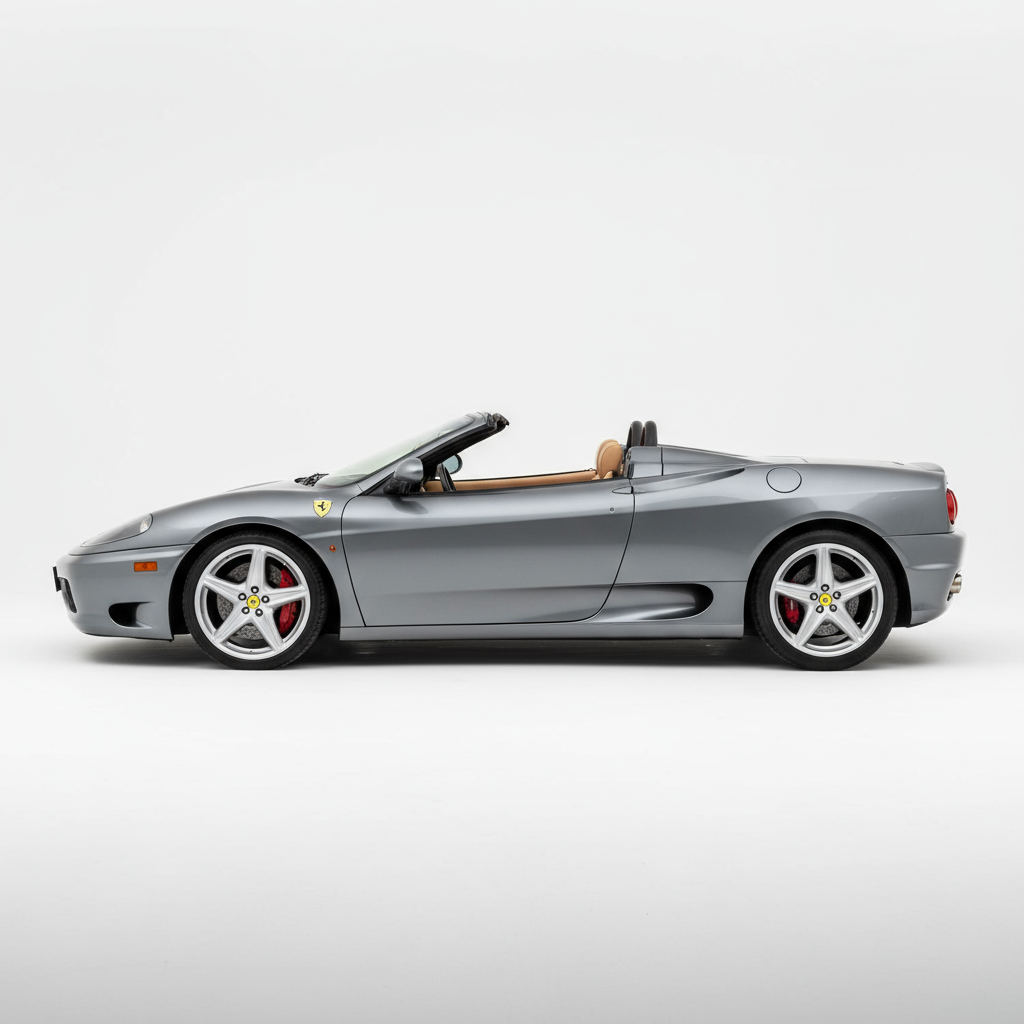

Especificaciones y análisis del Ferrari 360
Power
400HP
Torque
373Nm
Consumption
17.9l/100
Emissions
-g/km
0-100 km/h
4.6s
Top Speed
290km/h
Weight
1450kg
Price
169,536€
Technical summary
Gasolina
Manual 6v
RWD
2 / 2 doors
- L
95 L
294 kW
Current
Technical specifications
Engine
Capacities
Detailed analysis of the Ferrari 360 Spider · 400 CV (1999-2005)
General description
The Ferrari 360 Spider is not just a car, it's the materialization of an open-top dream. Born in 1999, it took over from the iconic F355 to redefine what a convertible supercar could be. With its exposed naturally aspirated V8 engine and a design that broke the mold, it invited you to feel the speed and sound of Maranello unfiltered, merging the driver with the asphalt and the horizon.
Driving experience
Driving the 360 Spider is a sensory overload. The scream of the 400 hp V8 revving up to 8,500 rpm right behind your head is an addictive and unforgettable melody. Every shift of its 6-speed manual gearbox is a precise mechanical act that connects you directly to the machine. The acceleration pins you to the seat, reaching 100 km/h in 4.6 seconds, while the wind and the engine's roar become the only soundtrack that matters. It's a visceral, pure, and unadulterated experience.
Design and aesthetics
The bodywork, sculpted by Pininfarina, is a work of art in motion. The 360 abandoned pop-up headlights for faired-in light clusters that defined a new era for Ferrari. Its greatest audacity was the glass engine cover, which proudly displayed the V8 heart like a jewel in its case. The fluid lines and large air intakes are not only beautiful but work in perfect harmony to generate downforce, sticking the car to the ground with brutal elegance.
Technology and features
Beneath its spectacular skin lies a monocoque chassis made entirely of aluminum, a first for a series-production Ferrari, which gave it far superior rigidity and lightness compared to its predecessor. The 3.6-liter V8 engine with 5 valves per cylinder was an engineering feat, capable of delivering power explosively in the upper rev range. The double-wishbone suspension on both axles ensured sublime dynamic behavior.
Competition
In its time, the 360 Spider faced legends that also sought to win the hearts of enthusiasts. The Porsche 911 Turbo Cabriolet of the 996 generation offered formidable power and efficiency with its all-wheel drive. Later, the Lamborghini Gallardo Spyder emerged as its natural Italian rival, with an equally dramatic design and the power of a V10 engine. Each offered a different interpretation of the open-top supercar.
Conclusion
The Ferrari 360 Spider is much more than the sum of its parts. It is a turning point in the brand's history, the bridge between the analog and digital eras. It represents the passion for driving in its purest form, a machine that demands from you and rewards you in equal measure. Owning and driving it is to guard a piece of the Maranello legend, an experience that has established itself as a true modern classic.