



Especificaciones y análisis del Mitsubishi Montero iO
Power
120HP
Torque
174Nm
Consumption
8.9l/100
Emissions
-g/km
0-100 km/h
10.2s
Top Speed
168km/h
Weight
1285kg
Price
18,175€
Technical summary
Gasolina
Manual 5v
AWD
4 / 3 doors
358 L
53 L
88 kW
Current
Technical specifications
Engine
Capacities
Detailed analysis of the Mitsubishi Montero iO 3p 1.8 GDI Plus · 120 CV (1999-2002)
General description
The 2000 Mitsubishi Montero iO, in its 3-door version with the 1.8 GDI Plus engine, presents itself as a compact and robust option within the SUV segment. Priced at €18,175, this vehicle aimed to offer the versatility and off-road capability of its larger siblings in a more manageable format for daily use. Its 120 hp gasoline engine, combined with all-wheel drive and a 5-speed manual gearbox, promised a balanced driving experience both on and off-road.
Driving experience
Behind the wheel of the Montero iO, the feeling is one of agility and control, especially on complicated terrain. The McPherson front suspension and rigid rear axle, although not the most comfortable setup for the road, offer a robustness that inspires confidence off-road. The recirculating ball steering, while not the most precise, fulfills its function in a vehicle of these characteristics. The 1.8 GDI engine, with its 120 hp and 174 Nm of torque, pulls with sufficient solvency, allowing an acceleration from 0 to 100 km/h in 10.2 seconds and a top speed of 168 km/h. The combined consumption of 8.9 l/100km is reasonable for the era and type of vehicle. Overall, it is a car that invites adventure, with honest mechanical response and predictable behavior.
Design and aesthetics
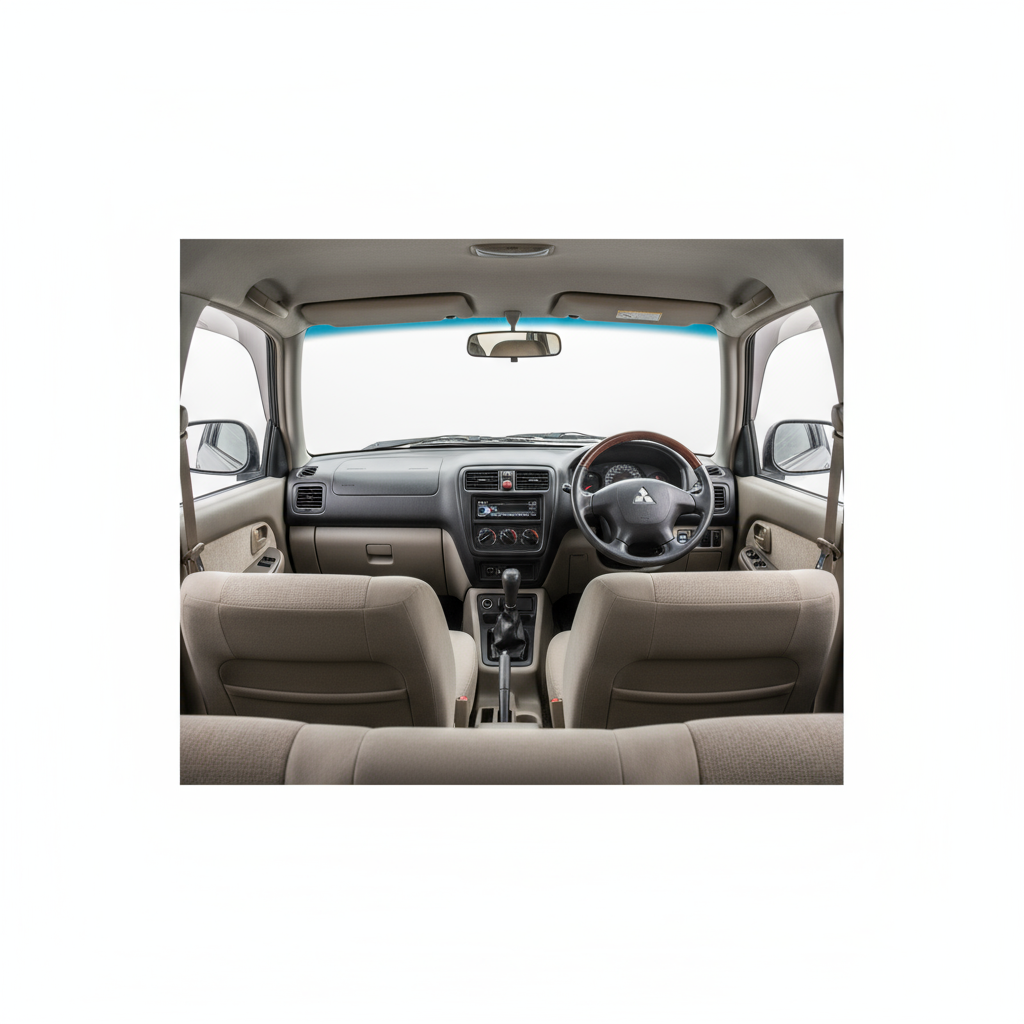
The design of the 3-door Montero iO is unmistakably Mitsubishi, with lines that evoke robustness and functionality. Its compact size, with 3735 mm long and 1695 mm wide and high, gives it an agile and urban appearance, without sacrificing the SUV image. The 215/65 R16 wheels, along with good ground clearance, reinforce its adventurous character. The interior, although functional, is simple and durable, designed to withstand demanding use. The 4-seater configuration and a 358-liter trunk make it practical for getaways or daily city use.
Technology and features
In 2000, the Montero iO incorporated solid and proven mechanical technology. Its 1.8 GDI (Gasoline Direct Injection) engine was one of Mitsubishi's innovations at the time, seeking greater efficiency and performance. All-wheel drive (AWD) is a fundamental pillar of its off-road capability, offering superior grip in various conditions. The 5-speed manual transmission, although conventional, is reliable and allows precise control over power delivery. In terms of safety, it features ventilated front disc brakes and rear discs, an adequate configuration for the vehicle's weight and performance. However, it lacks the electronic driving aids that we now consider standard, which makes it a more 'pure' car in its driving experience.
Competition
In its segment, the Mitsubishi Montero iO competed with other compact SUVs of the time, such as the 3-door Suzuki Grand Vitara, the first-generation Toyota RAV4, or even the Honda CR-V, although the latter with a more SUV-oriented approach. Compared to them, the Montero iO stood out for its robustness and its purer off-road capabilities, inherited from the Montero tradition. Its GDI engine offered an interesting alternative in terms of efficiency, while its compact design made it more agile in urban environments than some of its more voluminous competitors.
Conclusion
The 2000 Mitsubishi Montero iO 3p 1.8 GDI Plus is a compact SUV with a particular charm. It offers a combination of urban agility and off-road capability that made it attractive to those looking for a versatile vehicle. Its GDI engine, although not a powerhouse, fulfills its purpose, and its all-wheel drive ensures good performance off-road. It is an honest car, without great luxuries, but with mechanical reliability that makes it an interesting option for adventure lovers and vehicles with character. Its timeless design and robustness make it a modern classic for those who appreciate Japanese engineering of the era.