

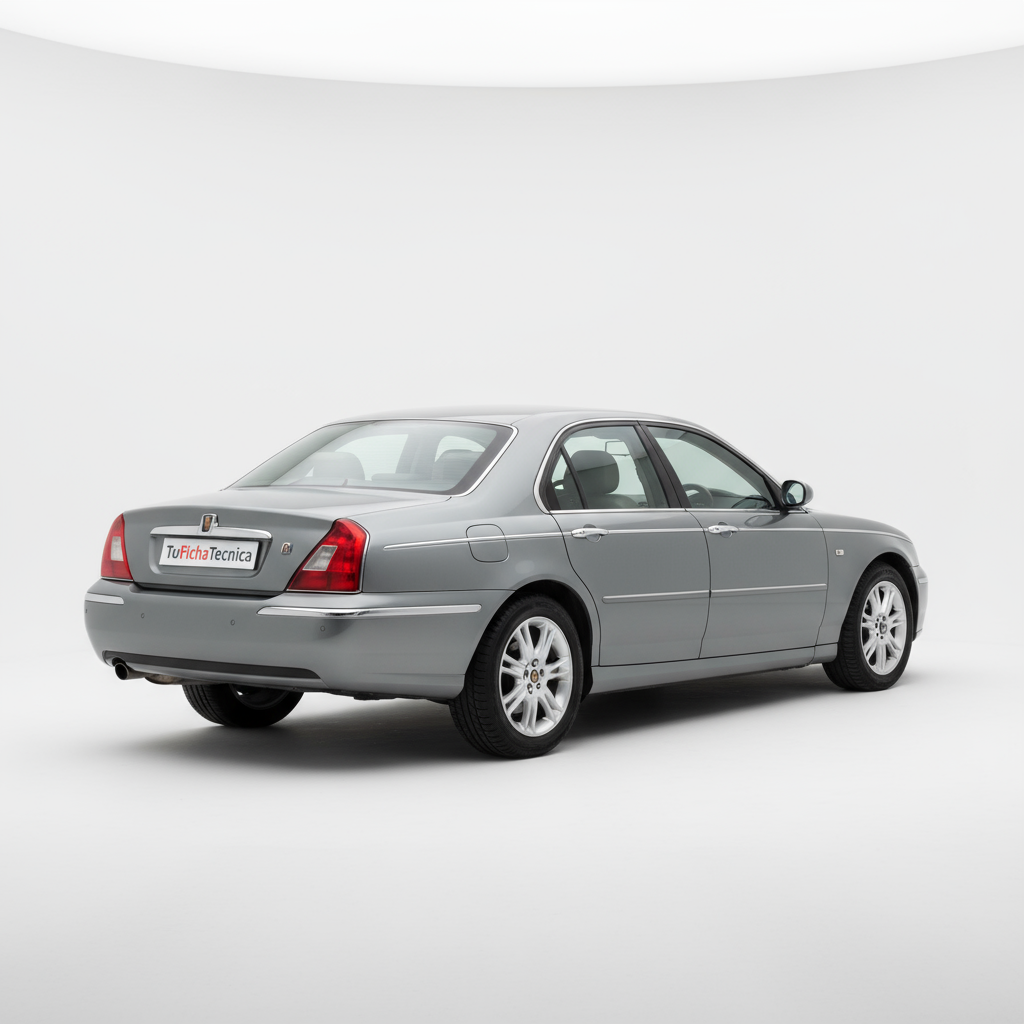


Especificaciones y análisis del Rover 75
Power
116HP
Torque
260Nm
Consumption
6.9l/100
Emissions
-g/km
0-100 km/h
13.2s
Top Speed
190km/h
Weight
1530kg
Price
31,828€
Technical summary
Gasóleo
Automático 5v
FWD
5 / 4 doors
432 L
65 L
85 kW
Current
Technical specifications
Engine
Capacities
Detailed analysis of the Rover 75 2.0 CDT Club (116 CV) Aut. · 116 CV (2001-2003)
General description
The 2001 Rover 75 2.0 CDT Club is a sedan that evokes an era of British elegance and distinction. With its 116 hp diesel engine and automatic transmission, it promised a comfortable and refined journey, ideal for those seeking a touch of accessible luxury in the mid-size sedan segment. Its classic design and focus on comfort set it apart from its sportier or more pragmatic competitors.
Driving experience
Behind the wheel of the Rover 75, the predominant sensation is one of calm and smoothness. The suspension, McPherson type at the front and deformable parallelogram at the rear, is tuned to absorb road irregularities masterfully, offering exceptional ride comfort. The diesel engine, while not a powerhouse with its 116 hp, delivers its 260 Nm of torque at low revolutions (2000 rpm), which translates into a progressive and relaxed response, perfect for long journeys. The rack-and-pinion steering, while not excessively communicative, performs its function with precision. Acceleration from 0 to 100 km/h in 13.2 seconds and a top speed of 190 km/h do not make it a sports car, but rather a serene and capable travel companion. The combined consumption of 6.9 l/100km is reasonable for the time and type of vehicle.
Design and aesthetics
The design of the Rover 75 is, without a doubt, one of its strongest and most distinctive points. Inspired by British automotive tradition, it features classic and elegant lines that give it a timeless presence. The four-door sedan body, with its 4747 mm length, 1778 mm width, and 1424 mm height, projects an image of solidity and sophistication. Chrome details, the characteristic front grille, and round headlights contribute to its retro-modern aesthetic. Inside, the atmosphere is equally refined, with quality materials and a design that prioritizes ergonomics and comfort for the five occupants. The 432-liter trunk is suitable for daily use and travel.
Technology and features
In 2001, the Rover 75 incorporated technology that, while not cutting-edge, was up to expectations in its segment. Its 1951 cc diesel engine with common rail direct injection, turbo, and intercooler, was a testament to efficiency for its time. The 5-speed automatic transmission offered smooth shifts and contributed to driving comfort. In terms of safety, it featured 284 mm ventilated disc brakes at the front and 280 mm discs at the rear, ensuring effective braking. Although advanced driving assistance systems are not specified, its chassis with independent suspensions and anti-roll bars on both axles provided good stability and control.
Competition
At the time, the Rover 75 competed in the upper-mid-size sedan segment, facing models such as the BMW 3 Series, Audi A4, Mercedes-Benz C-Class, or Volvo S60. While these rivals could offer a sportier approach or more advanced technology in some aspects, the Rover 75 stood out for its marked classic character, superior ride comfort, and British elegance, attracting an audience that valued distinction and smoothness over pure performance.
Conclusion
The 2001 Rover 75 2.0 CDT Club is a car that, despite the years, still retains a special charm. It is a sedan that prioritizes comfort, elegance, and smooth driving. Its timeless design and cozy interior make it an interesting option for those looking for a vehicle with character and a relaxed travel experience. Although its performance is not the highest, its diesel engine offers a good balance between performance and consumption, and its automatic transmission facilitates driving. It is a car to enjoy the road, with a touch of distinction that makes it unique.